
Leadership Conversations That Count 6 Sections51 Lessons4 Quizzes52 Weeks
Career Development Conversations
Career Development Conversations are not performance reviews and should never be about box ticking. It’s an opportunity to show people they matter.
They are reflective, future‑focused dialogues that help people explore:
- What they want
- Where they’re heading
- What experiences will help them grow
- How their strengths can be amplified
- How their potential can be realised
Career Conversations are most effective when run from a coaching mindset.
The manager’s role is to ask questions to prompt consideration and reflection by the individual around their future aspirations and perceived development requirements.
Principles for Effective Career Conversations
Shared Ownership: The employee drives their own path, while the manager provides guidance, time, and space.
Broad Focus: Discussions look at expanding skills, finding stretch projects, and building strengths – not just pushing for a promotion.
Curiosity Over Assumption: Open questions help uncover hidden talents, personal values, and real motivations.
Coaching Mindset: When applied by the leader, helps people see opportunities for improvement and identify practical ways forward for themselves.
Psychological Safety: the tone should be:
- Warm
- Curious
- Non‑judgmental
- Future‑oriented
Conversation Structure
Step 1 – Set the Scene
- “This conversation is about your future, not your performance.”
- “I want to understand what matters most to you.”
- “Let’s explore your aspirations and how we can support them.”
Step 2 – Explore Motivation & Values
- What motivates you?
- What disengages you?
- What new challenges excite you?
- What inspires you?
- What milestones matter to you in the next six months?
- What do you regard as the greatest risk to realising your goals?
- Which of your personal styles assist you?
- Which hold you back?
Step 3 – Explore Career Horizon
- Where do you see your career in the next 12 months?
- 5 years?
- 10 years?
- Do you see yourself as a generalist or specialist?
- What deeper technical understanding might you need?
Step 4 – Connect to the 9-box Grid for a Tailored Discussion
The 9 box grid model is a useful tool for assessing performance and potential, mapping both factors alongside each other to inform talent management and succession planning. It is a clear visual, identifying top performers and those with the ability to become leaders, as well as flagging employees who may need additional support. As you are preparing for career development conversations, placing team members on the grid in advance will help you prepare to have the right conversation with each of them (additional information about the 9 box grid is included below*).
Step 5 – Identify Experiences Needed
- What experiences do you need to step into desired moves?
- How could you gain this experience?
- What support do you need from me or the organisation?
Step 6 – Co‑create a Development Plan
- Learning on the job
- Secondments
- Mentoring
- leadership development programs.
Step 7 – Close with Commitment & Encouragement
- “I’m committed to supporting your growth.”
- “Let’s check in again in 6–8 weeks.”
*The 9-Box Grid for for Assessing Performance and Potential
The 9-Box Grid maps current role performance on one axis and future growth potential on the other.
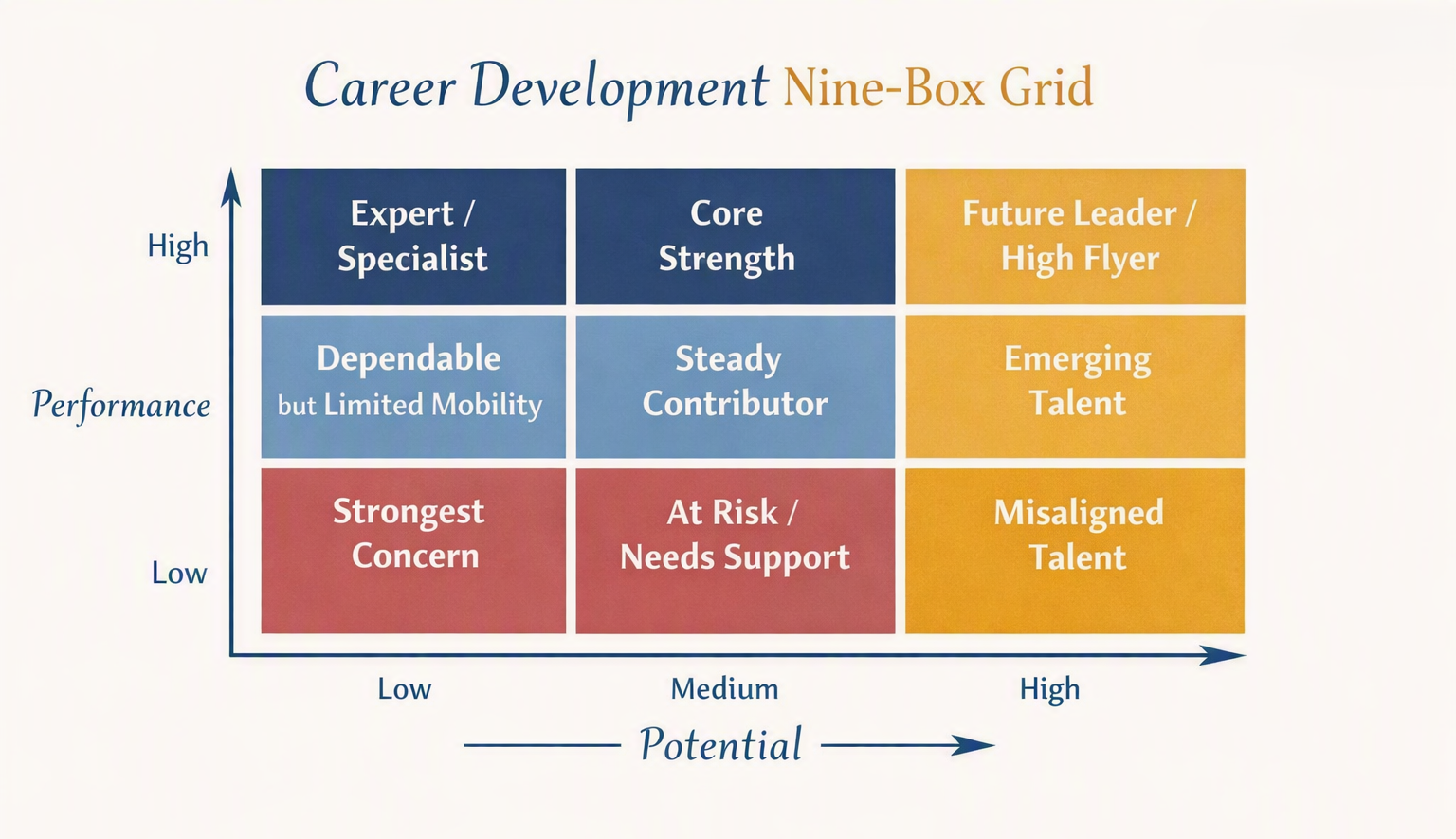
1. Low Performance / Low Potential = Strongest Concern
Struggling in the role with limited signs of improvement. Needs clear expectations, close support, and possibly a different role or exit pathway.
2. Low Performance / Moderate Potential = Uncertain
Not meeting expectations but shows some promise. Requires structured support, clarity, and regular check‑ins to lift performance.
3. Low Performance / High Potential = Unrealised Potential
Capable of much more than they’re delivering. May be new, unmotivated, or in the wrong role. Needs coaching, support, and possibly a role adjustment to unlock potential.
4. Moderate Performance / Low Potential = Solid Contributor
Meets expectations but unlikely to progress. Development should focus on strengthening current role rather than preparing for advancement.
5. Moderate Performance / Moderate Potential = Well Placed
Reliable and consistent. Some potential to grow, but not immediately promotion‑ready. Good candidates for targeted development and stretch experiences.
6. Moderate Performance / High Potential = Emerging Potential
Shows strong potential but needs to lift performance. With the right motivation, support, and stretch opportunities, could become a future high performer.
7. High Performance / Low Potential = Proven Performer
Delivers excellent results and is steady in their role. May not want or be suited for bigger roles, but is highly valuable and should be recognised and retained.
8. High Performance / Moderate Potential = High Achiever
Strong performer with some capacity to grow. With targeted development or skill-building, could step into broader responsibilities or leadership.
9. High Performance / High Potential = Top Talent
Exceptional performer with clear future leadership potential. Should be prioritised for stretch roles, sponsorship, and retention strategies.
The 9-Box Grid: Tailor the Discussion
Top Talent
Performs strongly… consistently delivering quality results.
Conversation focus:
- Retention
- Stretch
- Visibility
- Sponsorship
- Leadership pathway
Questions:
- What new challenges excite you?
- What experiences will prepare you for the next level?
- How can we raise your profile?
High Achiever
Shows moderate potential for more senior/complex roles.
Conversation focus:
- Broadening experience
- Strengthening leadership capability
- Exploring future aspirations
Questions:
- Which strengths do you want to deepen?
- What cross‑functional experiences would stretch you?
Emerging Potential
“Generally performs well and demonstrates high potential… likely to be promotion‑ready in near future.”
Conversation focus:
- Stretch assignments
- Confidence building
- Removing barriers
- Clarifying readiness
Questions:
- What gets in the way of good performance?
- What support would help you step up?
Unrealised Potential
“Performing below expectations despite high potential.”
Conversation focus:
- Role fit
- Barriers
- Support
- Coaching
- Resetting expectations
Question:
“What holds you back from achieving higher performance?”